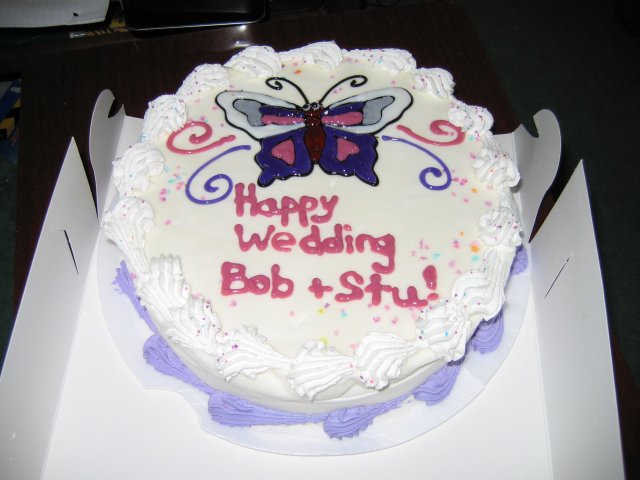
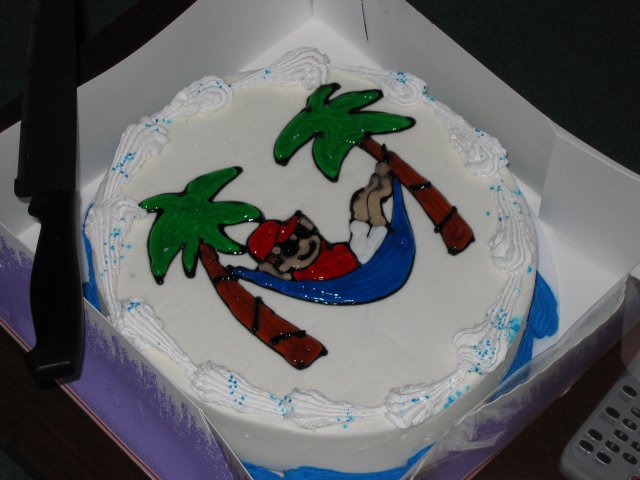
Another month, another ice cream cake. This time we got some writing on it, mainly to get some more sweet sweet gel icing. We also decided that something normal would be too...normal. So here we have the first gay-marriage friendly ice cream cake from Dairy Queen:
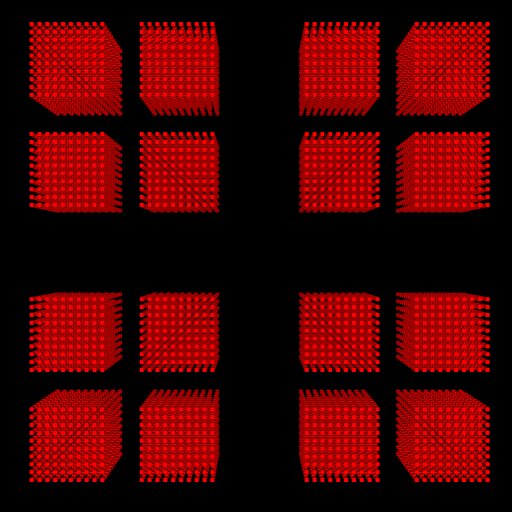
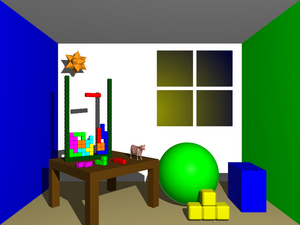
I am extending my raytracer for my final graphics project, and today I completed my first objective: hierarchial bounding volumes. This objective gives a significant performance increase, as demonstrated by the following image. It contains 16 sets of 1000 meshs (each individual mesh is a tetris cube similar to the ones I used in my final image for assignment four; the mesh has 26 faces). So doing some quick math, there should be 416000 faces in this scene, and since it is 512x512 there are 262144 primary rays sent into the scene. There are also 107177 shadow rays cast. That's a lot of stuff, but it only takes 155 seconds to render this image with my new feature implemented. With the feature turned off (or non-existant), it takes 10 hours and 32 minutes to do the same image.
This image is rendered with anti-aliasing turned on, so it takes longer to render than the times given above.
Another interesting statistic for the non-antialiased version of this image is the fact that in the bounding volume render, each ray is only tested against an average of 1.28 primitives, versus 16000 (all of them) in the non-bounding volume render. That's a huge difference and is what accounts for the huge difference in speed.
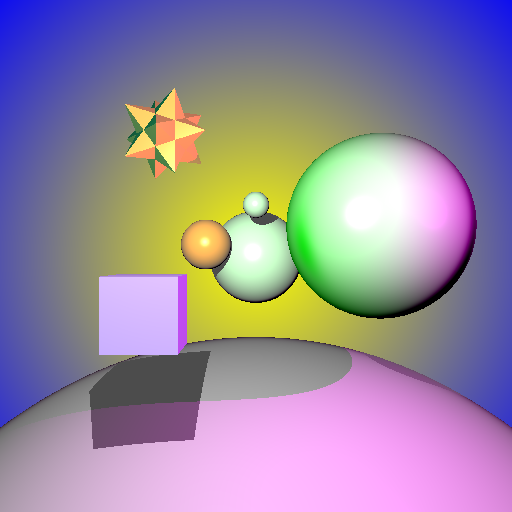
Here is my final image for my ray tracer, it took a while to render but it looks pretty good. I'd like to make a bigger copy, but that would take a REALLY long time. Maybe I will do it over the weekend.
I'm almost done my ray tracer assignment now. I've got all of the major objectives and I just need to make a "creative" scene of my own as well as look into the viewing transformation.
Here is a new sample image that we are required to render, I'll also post my "creative" scene once it is done.
Because of the cows and the antialiasing, this image took about 9 hours to render.
I've added antialiasing to my ray tracer as my extra feature, it looks really nice. You can especially see the difference comparing the box's shadow to the image in the previous post. The image below used 204,750,000 primary rays cast from the eye onto the scene. That's a lot.
So I've been working on my ray tracer a lot lately, and I've finally made some reasonable progress. Here is a sample image which exploits everything I've implemented so far:
Today is apparently National Chocolate Ice Cream day, so in celebration we bought a Dairy Queen ice cream cake, mmmmmmmm.
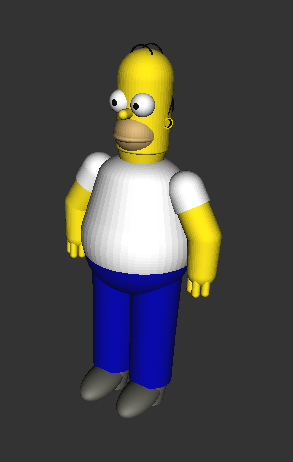
Ok, last time for real. I can't afford to spend any more time tinkering with Homer. So here is what should be the final version. I even made the tessellation a bit finer so that the image is nicer.
I did some more work on my puppet. Added a torus primitive which allowed me to give him cuffs on his pants and more definition around his eyes. I also gave in to the painful desire to give him fingers with proper joints. I'm much happier with his hands now in general. Other change include the hair on the top of his head, his ears, the definition of his torso and the size of his arms. Finally I fixed a mistake at the bottom of his right leg. Not sure if I will work any more on it, but if I do I would like to give him a collar on his shirt. I don't think that is very likely though, I really should move on to my other school work. Here is the latest:
Well, graphics is keeping me really busy, so in addition to not having enough time to post, I'm not doing a whole lot that is worth posting about.
Until now...
I just finished my puppet for Graphics assignment three. The assignment is to create a system for hierarchial modelling and then make a puppet using the system. There are all kinds of requirements, like joint range limiting, rotations, translations, etc, etc, so there was lots of work to do before even starting to model the puppet.
I chose to model Homer from The Simpsons because I have this 2x2x2 Rubric's cube of Homer's head which is useful for figuring out how things should look in 3D. I also have a giant Simpsons poster with most of the characters on it, so if it wasn't Homer it would have likely been someone else from the poster.
Here is Homer after rotating the view and "posing" him by manipulating his joints.